
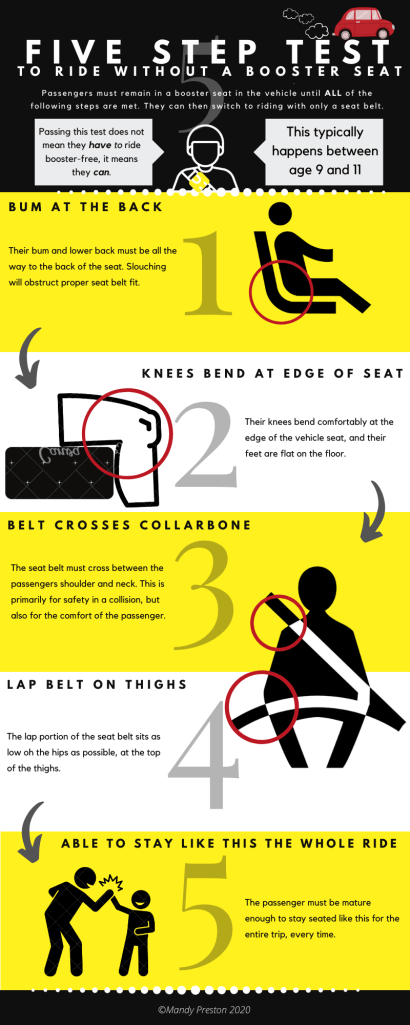
This week I have an infographic to share with you! It walks you through the five steps a passenger has to complete before they are ready to graduate from riding in a booster seat to riding with only a seat belt. One of the most important things to remember about this test is that every vehicle is different. While a passenger might pass the Five Step Test in some cars, they may not in every one, so make sure you check the steps every time they ride in another vehicle – and have their booster seat ready just in case!
One of the biggest complaints of older kids in booster seats is that they are “car seats for babies”. One way to combat this could be to let them choose their own seat, or get one that folds so it’s just that much cooler. At the end of the day, you are the caregiver, and it’s your job to keep them safe (even though they won’t always agree with you). Chances are, if they still need to ride in a booster seat, some of their friends do too!
The primary role a booster seat plays is to help the seat belt fit properly on a child’s body. There isn’t any reliable data to show that a once a harnessed seat is outgrown, a harness is safer than a booster seat, as long as it’s being used correctly: proper belt positioning, and a child can sit properly.
The reason the seat belt has to sit in the positions described in the infographic (collarbone and hips) is, of course, in case of a crash. The best place for a seat belt to be is on strong bones, so that the force of a collision goes there instead of to internal organs. Many seat belts can be adjusted, check where the top of the belt mounts to your vehicle if you’re unsure.
This might also be a good chance to review your own seat belt fit, and ensure that you’re “five stepping” every time you’re in a vehicle! It can be easy to develop bad habits, like slouching, especially when you’re a passenger.
On a final note: it is still not okay to use unregulated accessories when buckling up. Things like seat belt pads (those soft things that go around the portion of the belt that sits on the collarbone), and aftermarket seat belt adjusters are NOT SAFE to use, unless you’ve received explicit permission from the vehicle manufacturer.
Let’s keep working together to keep everyone safe in the car!

 Mandy's Car Seat Stuff

Very informative, thank you!
LikeLike
Hey Mandy,
Loved your infographic! The five easy steps were very easy to follow, and the pictures added a nice touch. I had to pick a friend and her kid up from the airport about a month or so ago and I had no clue as to whether or not I needed to snag a car seat from somewhere in advance; it would’ve been handy to have seen your blog post a while ago! P.s. I loved the layout of your infographic. Nicely done!
-Steve
LikeLike
Thanks Steve!
There’s essentially 3 kinds of car seats (rear facing, forward harnessed, booster). If the kid is under age 12, chances are they need to be in one of them, but it would definitely be hard to guess which one without having the primary caregiver let you know! Hopefully they had the seat with them that they needed 🙂
-Mandy
LikeLike
Hey Mandy,
Loved your infographic! The five easy steps were very easy to follow, and the pictures added a nice touch. I had to pick a friend and her kid up from the airport about a month or so ago and I had no clue as to whether or not I needed to snag a car seat from somewhere in advance; it would’ve been handy to have seen your blog post a while ago! P.s. I loved the layout of your infographic. Nicely done!
-Steve
LikeLike